Why Your Landed Cost Is Higher Than Expected: The True Cost of Fragmented Sourcing
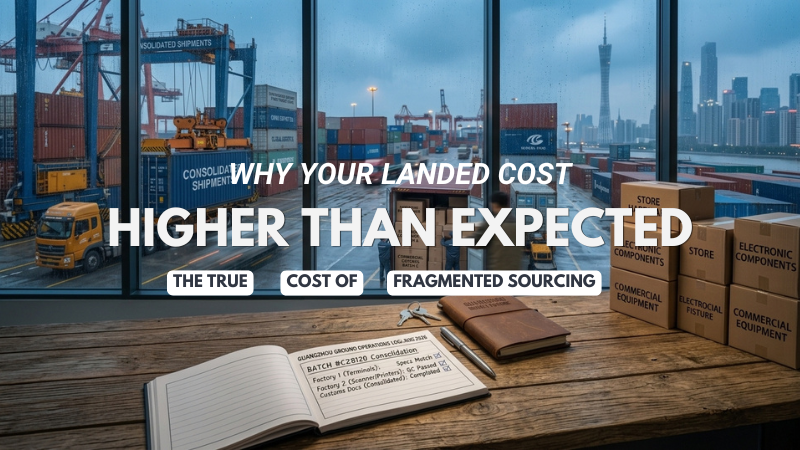
When importing commercial hardware, store equipment, or high-value manufactured goods from China, most global buyers calculate their target profit margins based on initial factory Free On Board (FOB quotes). However, when the final container arrives at the destination port, the actual landed cost frequently exceeds initial projections by 15% to 30%.
This unexpected margin shrinkage is rarely caused by manufacturing price increases alone. Instead, it stems from the structural inefficiencies of fragmented sourcing—managing multiple independent suppliers, uncoordinated shipping routes, and decentralized quality checks across different production hubs.
The True Arithmetic of Landed Cost
To understand why budget leakages occur, global procurement managers must evaluate the complete landed cost formula:
When sourcing from multiple decentralized factories, administrative fees, local trucking charges, and compliance overhead do not scale down—they multiply per vendor order.
The Hidden Profit Killers in Fragmented Sourcing
1. Duplicated Freight Fees and LCL Surcharges
Procuring separate partial loads forces buyers into multiple Less-than-Container Load (LCL shipping) arrangements. Each individual LCL shipment triggers its own fixed origin costs:
Separate bill of lading (B/L) issuance fees
Individual origin terminal handling charges (THC)
Multiplied inland trucking invoices from separate factory locations
Separate customs filing and export documentation fees
When three or four factories ship independently, these duplicate administrative surcharges quickly erode any volume discounts negotiated on the factory floor.
2. Undetected Quality Discrepancies and Spec Drift
Discovering hardware defects, incorrect voltage components, or cosmetic flaws after a container arrives at your domestic warehouse creates an operational crisis. Processing international returns or negotiating partial credit refunds is mathematically inefficient:
Without rigorous, on-site pre-shipment inspection conducted during production, minor factory specification drift can turn entire shipments into dead stock.
3. Port Storage Charges and Regulatory Demurrage
Managing fragmented export documentation across different factory sales reps increases exposure to customs holds. Common friction points include:
Mismatched Harmonized System (HS codes) across multi-item shipments
Incomplete export licenses or missing battery/power compliance test reports
Inconsistent commercial invoice valuations triggering customs audits
When freight is flagged at the port, authorities apply daily storage penalties—known as demurrage and detention fees—which can accumulate into thousands of dollars within days, completely wiping out net profit margins.
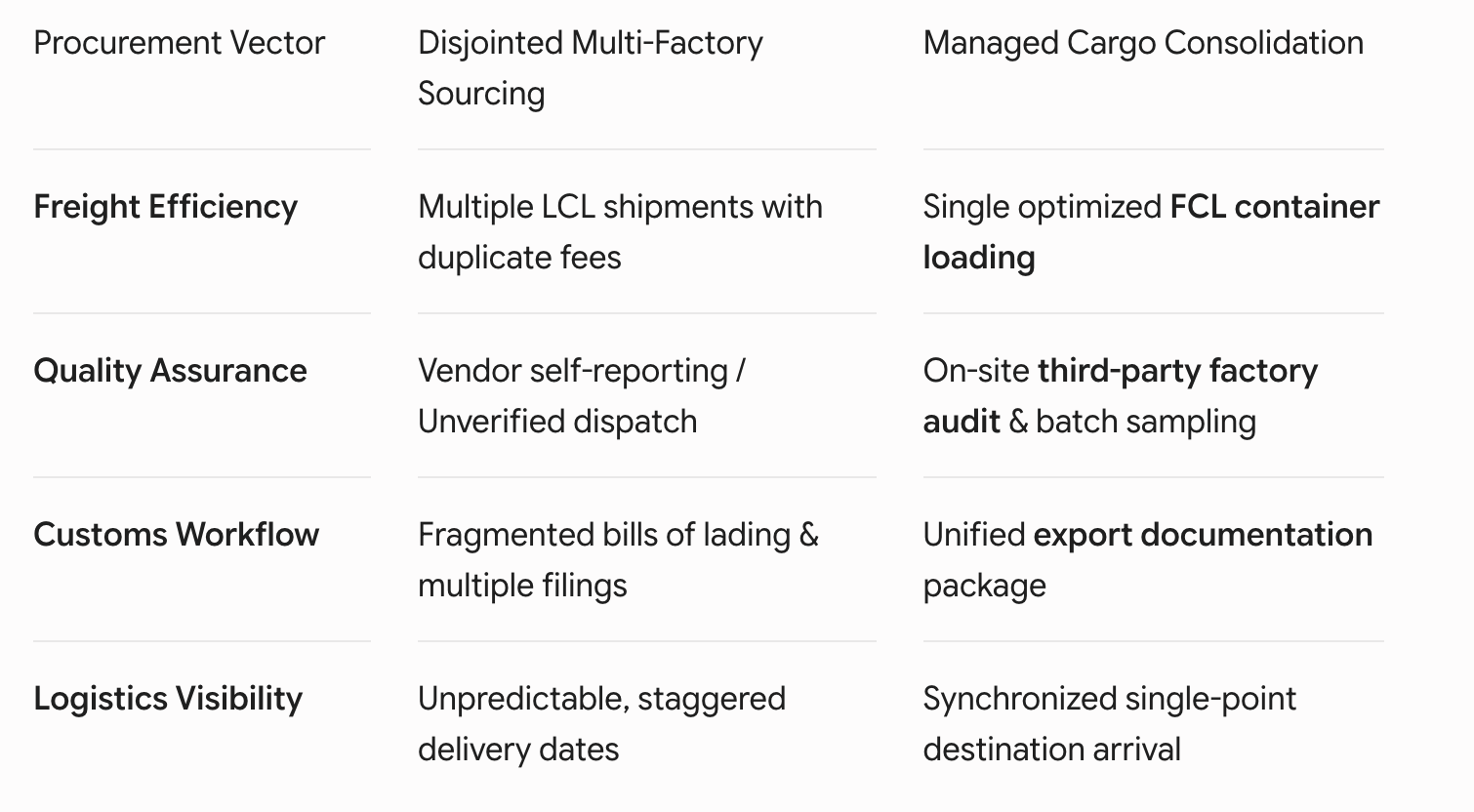
Structural Comparison: Fragmented Procurement vs. Consolidated Execution
How Local Cargo Consolidation Restores Margin Predictability
Achieving sustainable procurement margins requires transitioning to an integrated supply chain consolidation model located directly in primary trade gateways like Guangzhou.
Centralized Warehouse Operations
By routing goods from various regional manufacturers into a centralized Guangzhou logistics hub, importers can combine multiple vendor orders into a single Full Container Load (FCL). Maximizing volumetric utilization drastically reduces per-unit ocean freight rates while eliminating redundant origin handling costs.
Multi-Stage Quality Verification Workflow
Before cargo is stuffed into export containers, a local operations team executes a systematic inspection protocol:
Pre-Production Component Audits: Verifying technical spec sheets, casing durability, and electronic component stability before mass assembly.
Inline & Pre-Shipment Inspection: Conducting physical sampling, functional power tests, and drop tests on fully packaged units.
Packaging & Labeling Compliance: Ensuring outer cartons comply with international shipping regulations, barcode scanning standards, and protective cushioning.
End-to-End Trade Compliance & Tax Optimization
A dedicated local partner oversees the entire export lifecycle—from accurate landed cost calculations and tax formula optimization to securing compliant carrier bookings and streamlined customs clearance.
Protect Your Margins with Guangzhou Bright Future
Stop allowing unverified factory dispatches, split shipping fees, and unexpected port delays to eat away your hard-earned profit margins. At Guangzhou Bright Future, we serve as your on-the-ground China operations partner, delivering end-to-end supplier evaluation, multi-stage quality control inspections, and seamless container consolidation.
We bridge the gap between factory floors and international ports—ensuring complete specification compliance, lower landed costs, and total supply chain transparency.
Ready to optimize your China procurement strategy and eliminate hidden supply chain expenses?
👉 [Contact Guangzhou Bright Future Today] to consult with our logistics specialists and request a customized, consolidated freight quote for your next order!