China Sourcing vs Direct Factory Purchasing: Which Is Better for Global Buyers?
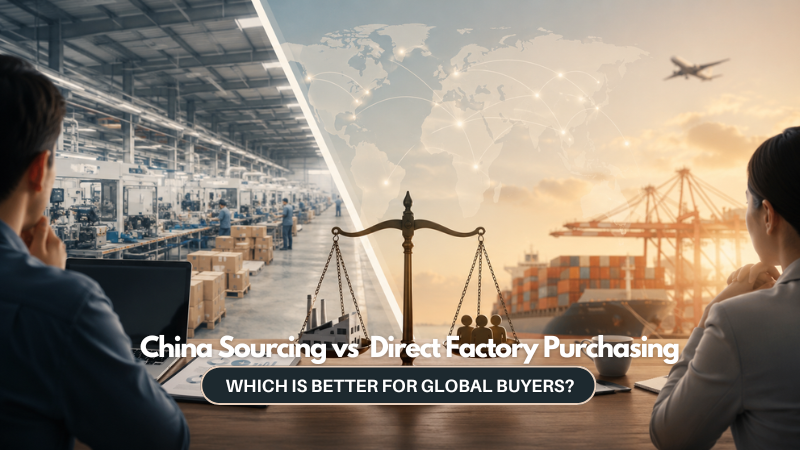
If you're planning to source products from China, one question usually comes up early:
Should you work directly with factories, or use a sourcing company?
At first glance, buying directly from manufacturers sounds like the cheaper and simpler option. But in reality, many importers discover that successful purchasing is not only about finding a factory — it is about managing suppliers, quality, timelines, and risks.
In this article, we compare direct factory purchasing and China sourcing services to help you decide which model fits your business.
What Is Direct Factory Purchasing?
Direct factory purchasing means buyers communicate and negotiate directly with manufacturers without involving intermediaries.
This method is often preferred by businesses that:
1. Already have sourcing experience in China
2. Understand production processes
3. Can manage quality inspections independently
4. Have teams for logistics and supplier coordination
Buying directly may help reduce intermediary costs, especially for large-volume orders.
However, finding the right factory is only one part of the process.
Many buyers discover challenges such as:
1. Difficulty verifying factory capabilities
2. Communication delays
3. Inconsistent sample and bulk quality
4. Production follow-up issues
5. Limited supplier options
Working with one factory also means relying heavily on a single production source.
What Is China Sourcing?
China sourcing involves working with a sourcing company or procurement partner that helps buyers locate suppliers, negotiate pricing, manage production, and coordinate shipping.
Instead of spending time searching factory by factory, buyers can access an established supplier network and receive support throughout the purchasing process.
Typical China sourcing services include:
✔ Supplier identification and verification
✔ Price negotiation
✔ Product sourcing support
✔ Sample coordination
✔ Factory audits
✔ Quality inspections
✔ Packaging customization
✔ Shipping arrangement assistance
For businesses entering China manufacturing for the first time, this often reduces operational complexity.
Direct Factory Purchasing: Advantages and Challenges
Advantages
Lower visible purchasing costs
Buying directly may eliminate additional service layers and sometimes provide competitive pricing.
Faster technical communication
If buyers already understand specifications and production requirements, direct communication can speed up development.
Better for experienced importers
Companies with sourcing teams and established processes may benefit from direct purchasing relationships.
Challenges
Supplier verification takes time
Not every supplier found online is necessarily the best fit.
A factory may specialize in one category but outsource another.
Without verification, buyers risk selecting suppliers based only on pricing.
Managing production becomes your responsibility
Buyers often need to handle:
1. Follow-ups
2. Sampling
3. Timeline tracking
4. Quality checks
5. Packaging confirmation
6. Logistics coordination
This workload increases as product lines grow.
Limited comparison options
Working with only one factory may reduce flexibility when prices change or production capacity becomes tight.
Why Many Buyers Choose a Sourcing Company
For growing brands and importers, purchasing is not only about finding the cheapest factory.
It is about reducing risk and improving efficiency.
A professional China sourcing company can help buyers:
Access multiple suppliers
Instead of relying on one manufacturer, sourcing partners often maintain networks across different industries and regions.
This creates more flexibility in pricing, MOQ, lead time, and production capacity.
Save communication time
Managing several factories across different products can become time-consuming.
A sourcing team centralizes communication and project tracking.
Improve quality control
One common issue in importing is that samples look perfect while bulk orders differ.
With quality inspection services, problems may be identified earlier before shipment.
Support scaling businesses
As product portfolios expand, managing suppliers internally becomes increasingly difficult.
Using procurement services in China can help streamline operations.
Which Option Is Better?
The answer depends on your experience level and purchasing needs.
Direct Factory Purchasing may suit you if:
1. You already source from China regularly
2. You have internal QC teams
3. You know factory verification processes
4. You manage logistics independently
China sourcing services may suit you if:
1. You are launching a new brand
2. You need multiple suppliers
3. You want supplier verification support
4. You need quality control assistance
5. You want to reduce sourcing risks
6. You prefer centralized purchasing management
Many successful importers actually combine both methods — maintaining direct factory relationships while working with sourcing partners for supplier expansion and project management.
Final Thoughts
Choosing between direct factory purchasing and China sourcing is not simply about cost.
It is about efficiency, reliability, and long-term scalability.
Factories manufacture products.
But sourcing involves much more:
Supplier selection, quality management, negotiations, timelines, inspections, and delivery coordination.
For businesses entering the China market, having experienced support often helps reduce mistakes and improve purchasing efficiency.
If your goal is not only to find a supplier but to build a more stable supply chain, exploring professional China sourcing company may be worth considering.